Tuesday, May 15, 2012

Carpobrotus glaucescens, Purple Noon Flower

Carpobrotus glaucescens
This spreading ground cover succulent is found along the sandy beaches of New South Wales and Queensland growing just above the high tide mark and also in the hind dune plant communities. I have seen it growing well in semi shade and even bordering swampy ground inhabited by the knobby club rush, Ficinia nodosa.
It is a versatile plant and has now become a popular landscaping choice away from the coast. It is used to great effect at Sydney Airport in the public gardens which welcome visitors to the country. Over summer it makes rapid growth, quickly covering a large area and is frequently smothered by purple flowers which are often given the name of coastal noon flower. The fruits which follow the flowers are edible and have the taste of salty apples but good fruit development requires the bright sun reflection of sand dunes and as such, garden specimens often don't go on to to develop fruit to maturity.  As the plant ages the leaves become red tinged and eventually wither and this can make for some unsightly patches. Regular tip pruning keeps the growth looking uniform but eventually the whole plant and its rope like growth may need to be removed and replanted with fresh specimens.
 I always associate this plant with the Arthur Streeton painting pictured below. It captures the glare of a hot summer day along the Hawkesbury River west of Sydney. 

 
The purple noon's transparent might (1896)
Arthur Streeton (1867 -1943)
National Gallery of Victoria, Melbourne

Monday, March 5, 2012

Lord Howe Island Wedding Iris

Dietes robinsoniana ,Lord Howe Island Wedding Iris
Most people probably don't realize that Lord Howe Island is part of New South Wales. It always comes up on the weather map between Brisbane and Sydney and the air temperature is somewhere between both cities. The most famous native plant of Lord Howe is the Kentia palm (Howea fosteriana) and this Iris comes a close second. However, ask any nursery grower about it and they will probably tell you it is tricky to produce in any quantity. Reason being is that in its native habitat it grows in pure sand in the full force of sea wind or eeks out a living clinging to the side of a mountain. Thus in a nursery situation it needs to be kept on the dry side or in a very sandy potting mix. In the garden it grows to be a handsome clump forming plant of about 1.5 metres tall with many stems bearing clusters of pure white flowers in early spring. The seed produced by the pant is enclosed in a capsule which is usually ripe around this time of year. I have just planted some of the seed collected over the past week.
The clump as it matures grows "fans" of new leaves which often have exposed roots like stilts at their base . It is possible to cut these off to grow new plants and these are best potted into pure sand. Though it is a very easy care garden plant, especially in breezy coastal gardens, it is a favourite of snails which are able to find a safe haven amongst the leaves. Occasional pruning and clearing the clump of old brown leaves helps keep it looking good.

Saturday, January 14, 2012

Flame Tree hybrids


Brachychiton 'Jasper Bells'
When I got an email from Peter this week promoting a native tree I nearly fell off my chair. He has never been one to even mention native plants let alone use them in his garden designs. So this tree is a hybrid between Brachychiton bidwilli and B spectabile and has been grown on B. rupestris rootstock. It and other different coloured hybrids are available from Brent Vieritz at Colours of Eden, 32 Bishops Road, Beachmere in Queensland. Telephone 07 54962181

Thursday, January 12, 2012

Myrtle Rust

Myrtle Rust on Lilly-Pilly , Syzygium australe

A friend rang me this week to tell me that the leaves on his Lilly Pilly were turning orange. When I went to visit, it turned out to be the dreaded myrtle rust so we removed the shrub and put it into plastic bags to kill the pest spores. We probably didn't need to take such drastic action, as a call to the Department of Primary Industries "pest hotline" gave very helpful advice on what fungicides to use to control its spread. (Their phone number in New South Wales is 1800 084 881) It is important to take a vigilant stance against the spread of myrtle rust . It affects all members of the Myrtaceae family including Gum trees (Eucalyptus), Bottlebrush (Callistemon and Melaleuca) ,Tea Tree (Leptospermum) ,Lilly Pilly (Syzygium, Acmena and Waterhousia ), Willow Myrtle (Agonis),Lemon Myrtle (Backhousia), Midyim Berry (Austromyrtus), Brush box (Lophostemon) New Zealand Christmas Bush (Metrosideros) and the fruiting exotic Gauva and Feijoa

Tuesday, January 10, 2012

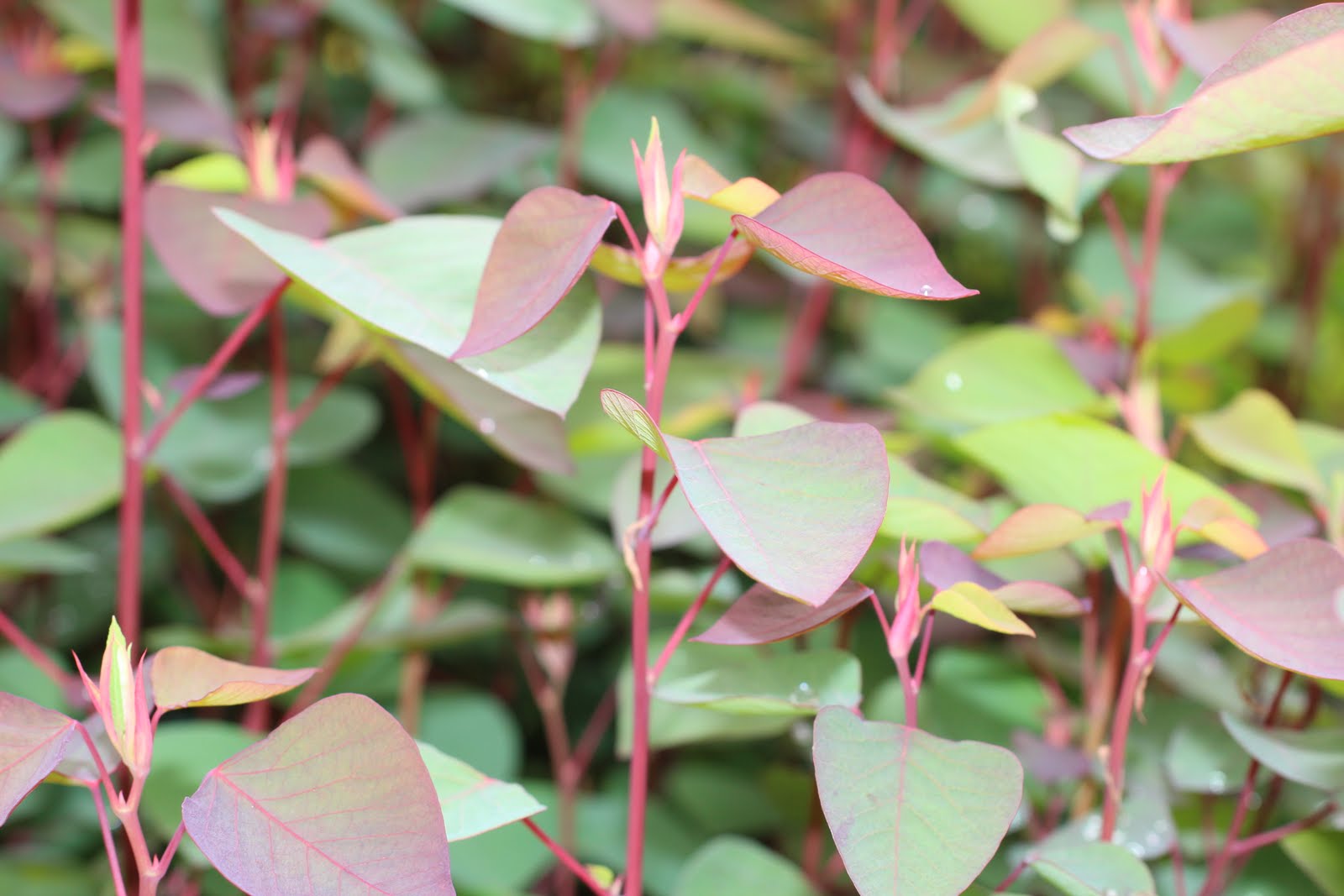
Homalanthus stillingifolius


Homalanthus stillingifolius syn Omalanthus stillingifolius
This shrub is native to dry rainforest and open woodland of the east coast and forms a dense rounded shrub to about 3 metres. It suckers at the base sending up many closely crowded stems but does not cover a great distance and at the most, a 1.5 metres spread is produced after a couple of years. The shrub is noted for its burgundy coloured leaves and red stems and like other members of the Euphorbia family, flowers are insignificant and not notable.This specimen was photographed in an garden of mainly exotic plants and it is maintained like many shrubs these days by a quick once over with powered hedge trimmer to keep it at a desirable height.
It certainly deserves to be better known as an easy care shrub for ornamental and screening purposes. Like many native plants however it fails to look particularly interesting in a pot and may only come into its own after a couple of years in the ground.